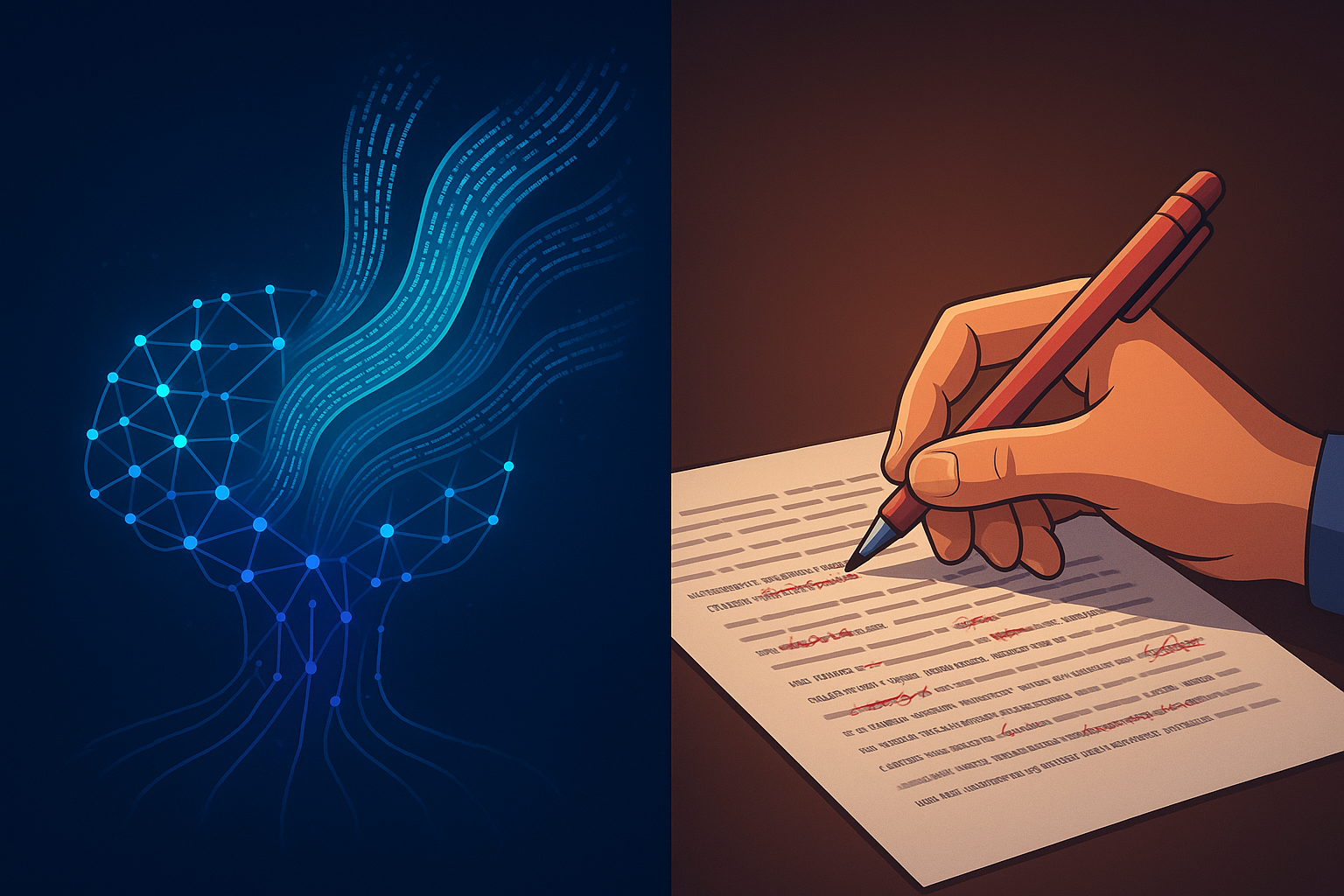
The AI Content Paradox: Balancing Automation and Human Authenticity
The AI content paradox is real! Discover why marketers secretly use AI & how to blend automation with human touch. Create content that resonates & ranks!

The AI Content Paradox: AI vs Human Content Creation
I observed a peculiar situation recently. During an initial call, a marketing director at a Series B startup insisted their content team "doesn't touch AI tools." However, three weeks later, during an offsite visit, I noticed multiple browser tabs open on her laptop: ChatGPT, Jasper, Claude, Copy.ai, and Grammarly. When questioned, she laughed and said, "Oh, we use AI. We just don't rely on it."
This disconnect between perception and reality encapsulates the state of AI content in 2025. Research from Siege Media and Wynter indicates that 90% of content marketers plan to leverage AI in their content efforts this year [1]. Yet, when asked directly, many marketers hesitate to admit they "use AI."
The reality is more nuanced than the headlines suggest. AI-generated content isn't eliminating creativity or replacing writers. Nor is it a magical solution for effortless content creation. The truth lies somewhere in between—more interesting and ultimately more useful.
The Conversion Numbers Everyone's Whispering About
Contrary to skeptical viewpoints, data reveals that AI content often performs better than human-written content. Marketers using AI-generated content report 36% higher conversion rates on landing pages compared to traditional approaches [2]. Zebracat's analysis of ad performance showed that AI copywriting tools improved click-through rates by 38% while cutting cost-per-click by 32% [2].
Higher conversion rates on landing pages
Marketers using AI-generated content report 36% higher conversion rates on landing pages compared to traditional approaches
Source: Zebracat/Google
Seer Interactive's six-month tracking of ChatGPT traffic found a conversion rate of 15.9% compared to 1.76% for Google organic traffic [3]—a nine-fold increase. Ahrefs discovered that AI recommendations have a 23x higher close rate than organic search [4].
Shane Hegde's GEO white paper [5] sheds light on this phenomenon. Google searchers tend to use 2-3 keywords, while ChatGPT users average 10-11 words per query, providing more context. This allows AI to better match user intent, resulting in higher conversion rates.
Semrush found that ChatGPT users click through to external websites twice as often as Google users—1.4 links per session versus 0.6 [6]. This suggests greater trust in AI's filtering capabilities.
The Cost Equation That Doesn't Add Up
The apparent cost savings of AI tools can be misleading. While ChatGPT Plus costs $20 per month, Jasper starts at $39-$49, Claude is $20 per month for the Pro tier, and Copy.ai starts at $29 per month [7, 8], these are just the base costs. A writer producing a 1,500-word article may charge $175 or more [9], making AI tools seem significantly cheaper.
However, according to Memberful [10], businesses often subscribe to multiple AI tools—writing assistants, image generators, SEO optimizers, chatbots—leading to escalating costs. Furthermore, even the best AI outputs require human editing, consuming 30-40% of the "saved" time [9].
The true value of AI lies in increased content velocity. Firewire Digital [11] found that organizations using AI report 59% faster content creation and 77% higher output volumes. Teams are not replacing writers but enabling them to produce more by shifting focus to strategy and editing.
One of my clients cut their content production time by 45% using AI for research, outlines, and first drafts while retaining two full-time writers for refinement, brand voice, and strategic planning. They now produce twice as much content at roughly the same budget.
Social Media Is Where Things Get Strange
Businesses using AI for social media content generation report a 15-25% increase in engagement rates [12]. According to Artsmart AI's research [12], 71% of social media images are now AI-generated, and over 80% of content recommendations are powered by AI algorithms [12].
However, platforms are now actively trying to differentiate AI content from human content. Meta launched Vibes, a short-form video feed featuring only AI-generated clips [13]. Pinterest labels AI-generated or modified pins [13]. Reddit strengthened tools to detect AI-driven bots [13].
By November 2025, generative AI content accounted for 57% of all online material [13], with some predicting it could reach 90% by mid-2025 [14].
Users are reacting to this influx of AI content. Research from Digital Silk [12] shows that 62% of global marketers believe required labels for AI-generated content would positively impact social media performance. People want transparency.
This creates a paradox: AI content performs well, but audiences increasingly demand transparency about its origins. Social media managers are now tasked with scaling content production using AI while maintaining an authentically human voice. The successful ones use AI for repetitive tasks like resizing images and scheduling posts, while retaining human judgment for strategy and nuance.
The Quality Problem That Won't Go Away
Let's address the elephant in the room: much AI-generated content is mediocre. In blind tests, 84% of readers couldn't distinguish between human and AI-generated content [11]. While seemingly impressive, this may indicate that AI has successfully mimicked the average.
Content optimized using AI shows 32% higher engagement rates and 47% better conversion rates compared to non-optimized content [11]. However, EY's research [15] highlights that AI content often lacks depth, nuance, and genuine human perspectives, which are crucial for context and understanding.
Studies from Cambridge and Oxford show that AI systems trained primarily on AI-generated content lose touch with reality, creating increasingly distorted outputs [14]. This feedback loop is already evident in certain niches.
A Northwestern University study found that while people can't reliably distinguish AI from human writing, AI content scored 3% lower on perceived quality while generating 31% higher engagement metrics [16]. This suggests that while AI content performs well, it may lack a certain something.
I've observed that high-performing AI-generated content often receives comments like "helpful but generic" or "lacking specific examples." It answers the question and ranks well but doesn't leave a lasting impression.
Where to Go If You're Actually Doing This
The AI tool landscape can be overwhelming, so here's a breakdown of options based on your specific needs:
- Writing and Editing: ChatGPT and Claude are versatile options for long-form content, brand voice, and tone adaptation. ChatGPT Plus costs $20 per month [7], as does Claude's Pro tier [7]. Both offer free tiers with usage limits.
- Marketing Teams: Jasper (starting at $39-$49 per month [17]) and Copy.ai (starting at $29 per month [7]) are purpose-built with templates for product descriptions and ad copy.
- Social Media: Tools like FeedHive (starting at $15 per month [18]) and ContentStudio offer AI writing assistants, performance predictions, and scheduling.
- Images: Canva's Magic Studio [19] includes AI image generation, editing, and design features. Midjourney and DALL-E remain leaders for pure AI image generation.
- Video: Google Veo 3 costs $19.99 per month, while OpenAI's Sora starts around $20 [20]. Synthesia [20] specializes in avatar-led corporate and explainer videos.
Start with the free tiers of ChatGPT or Claude to assess your needs before investing in specialized tools. Most businesses need 2-3 tools max.
What Actually Works (From Watching People Do This Wrong)
Having observed numerous AI content strategy implementations, I've identified key patterns that differentiate success from failure:
- Don't hide AI use: Openly acknowledge AI's role in your content process. For example: "We use AI to research, outline, and draft, then our team edits and adds perspective."
- Measure differently: Track revision time, content velocity, and cost per published piece. Calculate "editing burden" to assess the time spent fixing AI outputs.
- Don't optimize for AI alone: Use AI as part of a larger strategy, not as a replacement for strategy. Colorwhistle's research [16] shows that organizations leveraging AI for content performance prediction report 68% higher content ROI.
- Keep the human at the end: Use AI for structure and research, but retain human judgment for nuance and voice. One team uses AI to generate outline options, then a human selects the best and adds unique angles. The AI then drafts the article, followed by human rewriting of the introduction and conclusion, adding specific examples, and adjusting the voice.
The Thing Nobody's Saying Out Loud
AI-generated content can be powerful when used correctly. It converts well, performs well, and helps teams scale output without proportionally scaling costs.
However, the best-performing content still requires human judgment at every step. The AI can draft, but it can't decide what's worth saying or who needs to hear it. It can optimize for clicks, but it can't build trust with an audience over time.
The paradox is that AI content works—right up until everyone's using it. Copyleaks [22] found that 60% of outputs generated by GPT-3.5 contained some form of plagiarized content. As more content gets created by AI trained on AI-generated content, the quality baseline drops, and readers become more skeptical.
Businesses that succeed with AI content are the ones using it strategically—letting AI handle the repetitive and scalable while keeping humans responsible for the original, strategic, and relationship-building.
What Comes Next (Probably)
Predictions about AI are speculative, but the general direction is clear. The technology will continue to improve, costs will likely stabilize or decrease slightly, and more specialized tools will emerge.
However, the fundamental tension will persist. AI-generated content will become better at mimicking human writing, but readers will become better at spotting patterns and preferring authentic perspectives. Platforms will continue to add labels and verification systems. Quality will remain a persistent challenge as more AI content trains future AI models.
The businesses that thrive will treat AI as a production multiplier, not a replacement for thinking. They'll use it to scale research, outlining, optimization, and formatting while keeping humans involved in judgment, nuance, and voice.
The real value of AI content isn't that it can write like a human but that it can handle the boring parts fast enough for humans to focus on saying something worth reading, backing it up with real perspective, and building relationships with an audience that trusts you because you consistently deliver valuable insights.
This is harder to measure than conversion rates, but it's what separates content that performs from content that lasts.
Ready to optimize for the future of search?
Sapt helps scaling businesses dominate AI search results.
References
- [1] Siege Media + Wynter: AI Writing Statistics 2025. https://www.siegemedia.com/strategy/ai-writing-statistics
- [2] Zebracat/Google: AI content marketing performance metrics. https://www.siegemedia.com/strategy/ai-writing-statistics
- [3] Seer Interactive: Case Study: 6 learnings about how traffic from ChatGPT converts. https://www.seerinteractive.com/insights/case-study-6-learnings-about-how-traffic-from-chatgpt-converts
- [4] Ahrefs: AI search traffic conversions study. https://ahrefs.com/blog/ai-search-traffic-conversions-ahrefs/
- [5] Shane Hegde: The GEO white paper: Optimizing brand discoverability in models like ChatGPT. https://medium.com/@shaneht/the-geo-white-paper-optimizing-brand-discoverability-in-models-like-chatgpt-perplexity-and-ee741613dfb3
- [6] Semrush: AI SEO statistics. https://www.semrush.com/blog/ai-seo-statistics/
- [7] DemandSage: 10 AI Tools for Content Creation 2025. https://www.demandsage.com/ai-tools-for-content-creation/
- [8] DHiWise: The Best AI Content Generation Tools in 2025. https://www.dhiwise.com/post/the-top-ai-content-generation-tools
- [9] GetBlend: 12 Best AI Tools to Use for Content Creation in 2025. https://www.getblend.com/blog/10-best-ai-tools-to-use-for-content-creation/
- [10] Memberful: The Hidden Costs of AI-Powered Content Creation for Membership Businesses. https://memberful.com/blog/hidden-costs-of-ai-powered-content-creation-for-membership-businesses/
- [11] Firewire Digital: 25 Key AI Writing Statistics For 2025. https://www.firewiredigital.com.au/content/ai-writing-statistics/
- [12] Artsmart AI: AI in Social Media: 20 Powerful Statistics in 2025. https://artsmart.ai/blog/ai-in-social-media-statistics/
- [13] PYMNTS: Social Media Overhaul Platforms to Separate AI Content. https://www.pymnts.com/news/artificial-intelligence/2025/meta-pinterest-other-social-media-overhaul-platforms-separate-human-ai-content/
- [14] Digital Literacy Licence: The Internet's Quality Crisis. https://www.digitalliteracylicence.com/blog/qualitycrisis
- [15] EY: AI-generated content in transition – between progress and fatigue. https://www.ey.com/en_ch/insights/ai/ai-generated-content-challenges-and-opportunities
- [16] Colorwhistle: AI in Content Marketing: Key Statistics & Trends. https://colorwhistle.com/statistics-ai-content/
- [17] Piktochart: Top 10 Best AI Content Generator 2025. https://piktochart.com/blog/best-ai-content-generators/
- [18] Zapier: The 8 best AI tools for social media management in 2025. https://zapier.com/blog/best-ai-social-media-management/
- [19] Synthesia: The 45 Best AI Tools in 2025. https://www.synthesia.io/post/ai-tools
- [20] ImagineArt: How Much AI Video Generators Cost. https://www.imagine.art/blogs/ai-video-generators-cost
- [21] Single Grain: AI Marketing Strategies for Maximum ROI in 2025. https://www.singlegrain.com/digital-marketing-strategy/ai-marketing-strategies-for-maximum-roi-in-2025-the-data-driven-playbook-for-cmos/
- [22] Purple Iris: AI in Content Writing: Strategies to Protect Content Authenticity. https://purpleiriscomms.com/ai-in-content-writing-strategies-to-protect-content-authenticity/
Ready to optimize for the future of search?
Sapt helps scaling businesses dominate AI search results.
Get Started TodayRelated Posts

Quality Over Quantity: Win AI Search by Publishing Less Content
AI search favors quality over quantity! Learn how to create comprehensive content, build E-E-A-T, and outperform competitors by publishing less, but better, content.

Schema Markup: The Key to Getting Cited by AI Search Engines
Is AI missing your business? Unlock AI search citations with schema markup. Learn how structured data makes your website AI-friendly and drives targeted traffic. Get found!

AI Search Revolution: The Death of Traditional SEO in 2025
AI search is exploding! Is traditional SEO dying? Discover why 77% of Americans now use ChatGPT for search and how to future-proof your digital marketing strategy.