Back to Insights

AI Search Revolution: The Death of Traditional SEO in 2025

AI search is exploding! Is traditional SEO dying? Discover why 77% of Americans now use ChatGPT for search and how to future-proof your digital marketing strategy.

Sapt Team
October 11, 2025
7 min read
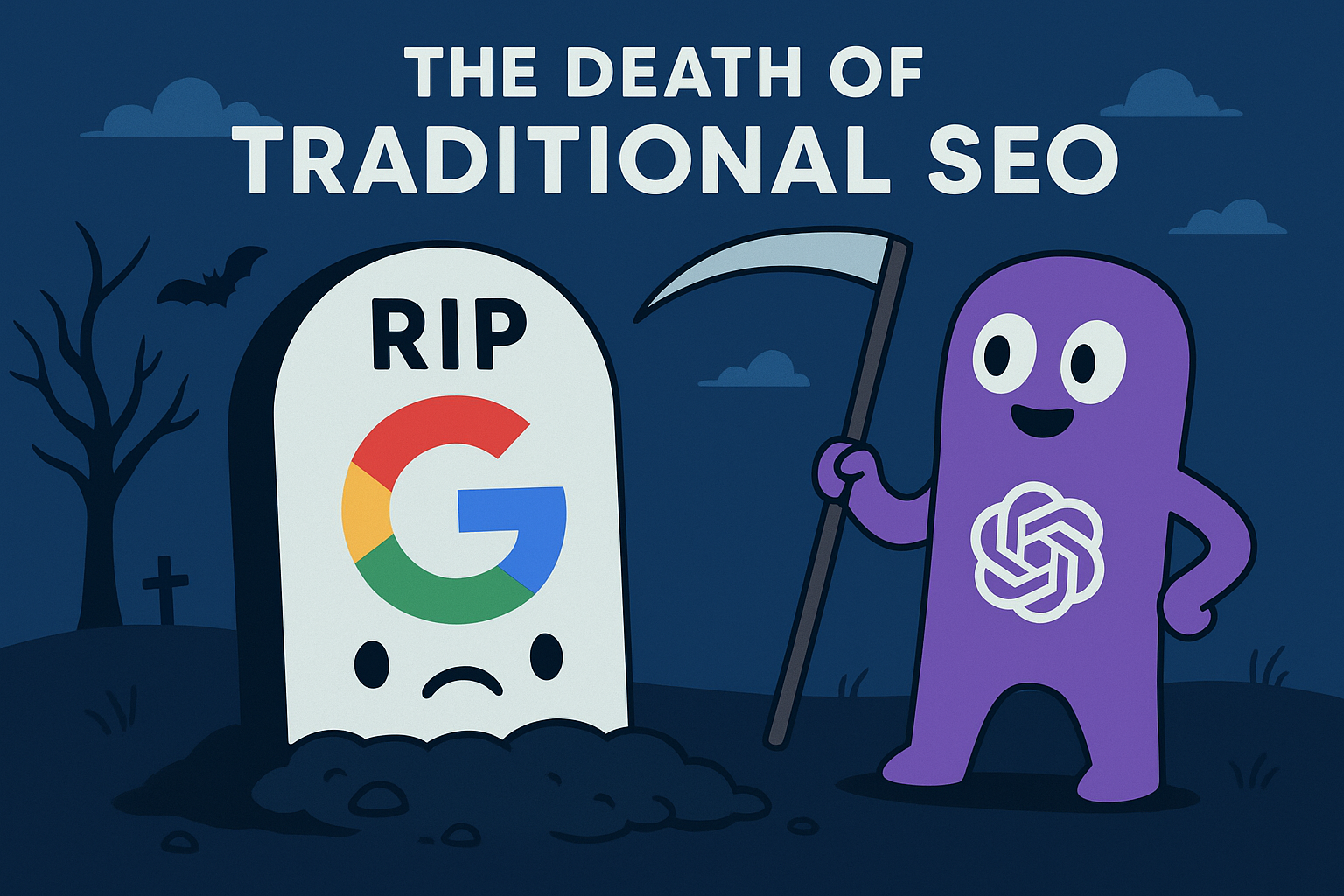
Chart showing the decline of Google's search market share and the rise of ChatGPT as a search engine in 2024.

I've been tracking search behavior for the past year, and December 2024 marked something I never thought I'd see: Google's search market share dropped below 90% for the first time since 2015. It landed at 89.7% Search Engine Land: Google search market share drops below 90% in December 2024.

That might not sound like much. A 0.3% dip? Big deal. But here's what the numbers don't immediately show: this isn't a plateau or a temporary blip. The shift is accelerating, and 77% of Americans are now using ChatGPT as a search engine ContentGrip: 77% of Americans use ChatGPT as a search engine. Not as a writing tool. Not for brainstorming. As their primary way to find information.

SE Ranking published a study tracking AI traffic over 12 months, and the data is stark: AI-driven search traffic grew 7x in one year. Not 7%. Seven times. That's the kind of exponential curve that changes industries overnight.

0

Growth in AI-driven search traffic in one year

Source: SE Ranking

The Conversion Data Tells a Different Story

When Seer Interactive ran a six-month analysis of ChatGPT traffic, they found something that contradicts everything we thought we knew about search visitor quality. ChatGPT traffic converts at 15.9%. Google organic? 1.76%.

0

ChatGPT Traffic Conversion Rate

Compared to Google organic at 1.76%

Source: Seer Interactive

AI search visitors are 9x more likely to convert than traditional search visitors.

Ahrefs ran their own numbers and found something even more extreme: AI recommendations have a 23x higher close rate compared to organic search. When an AI suggests a company, people don't just click. They buy.

0

Higher Close Rate for AI Recommendations vs. Organic Search

Source: Ahrefs

Why People Prefer AI Search (And It's Not What You Think)

The GEO white paper from Shane Hegde analyzed query patterns across both traditional and AI search. The difference in how people search is more revealing than the conversion numbers.

Google searches average 2 to 3 keywords. "plumber chicago." "best coffee maker." "wordpress hosting." These are compressed thoughts, trained behavior from two decades of learning how Google works.

AI platform queries average 10 to 11 words. People talk to ChatGPT the way they'd talk to a knowledgeable friend. "I need a plumber in the West Loop area who can come today because my kitchen sink is backing up into the dishwasher." The intent isn't just clearer—it's complete. No guessing. No multiple searches to narrow down what someone actually wants.

Quick example: Semrush tracked user engagement patterns and found that ChatGPT users click through to external websites twice as often as Google users. ChatGPT averages 1.4 link clicks per session. Google? 0.6.

Think about what that means. On Google, people scan ten blue links, check a few titles, maybe click one or two, then refine their search. On ChatGPT, the AI pre-filters everything, and when it recommends something, people actually follow through.

Google is Trying to Compete, But It's Making Things Worse

In May 2024, Google rolled out AI Overviews to over 50% of queries. The idea was sound: generate AI summaries at the top of search results to compete with ChatGPT and Perplexity.

The result? Zero-click searches jumped from 56% to 69% between May 2024 and May 2025 Digiday/Similarweb: AI platforms are driving more traffic but not enough to offset zero-click search. People read the AI summary and leave. No clicks. No traffic to your site.

When Ahrefs analyzed the impact on click-through rates, they found that when AI Overviews appear, the #1 organic position loses 34.5% of its clicks. That's not a small hit. If you ranked #1 before May 2024 and got 1,000 clicks per month, you're now getting 655. Same ranking. Same content. The game just changed.

0

Click Loss for #1 Organic Position with AI Overviews

Source: Ahrefs via Search Engine Land

The Traditional SEO Spend Problem

I pulled pricing data from Siege Media, WebFX, and Clutch. The average business spends $2,800 per month on traditional SEO. That's $33,600 per year. Agencies promise better rankings, more traffic, higher revenue.

But WordStream surveyed 500 marketers in late 2024, and 39% reported declining website traffic since Google launched AI Overviews. Not stagnant. Declining. You're paying more for less, and the trend is accelerating.

0

Of Marketers Reporting Declining Traffic Since AI Overviews

Source: WordStream

The math doesn't work anymore. Premium prices for strategies that deliver less traffic every quarter.

What This Actually Means If You Run a Service Business

If you're running a service business, an operation with multiple locations, or any company that depends on being found online, the shift is already affecting you. Your customers aren't using Google the same way anymore. They're opening ChatGPT and typing full descriptions of their problems.

"I have a leaking pipe under my kitchen sink that started this morning. It's dripping about once per second. What kind of plumber do I need and roughly how much should this cost to fix? Can they come today?"

That query tells you everything. The person knows exactly what they need, they've thought through the urgency, and they're ready to book someone right now. These aren't tire-kickers. They're qualified leads who've already done their research.

According to Views4You's 2025 AI usage report, ChatGPT hit 800 million weekly active users. And Semrush projects that by 2028, AI platforms will drive more traffic than Google for digital marketing and SEO-related queries.

Half of users surveyed by Ethical SEO believe AI search could fully replace traditional search within five years. Not "might." Not "could possibly." Will.

What Works Now (And Why the Approach Is Different)

The businesses that adapt aren't abandoning SEO fundamentals—they're building on them. AI platforms still value authority signals like backlinks and domain credibility. But they weight different factors more heavily than Google does. They prioritize clear, structured information that language models can confidently parse and cite.

This means you need content and data formatted for both human readers and AI systems. Service descriptions that explain exactly what you do and who you serve. Clear information about your offerings. Specific customer outcomes with measurable results. Operational details like service areas, response times, and availability. All of it marked up with structured data that makes it easy for AI to extract and verify.

You also need to appear in the sources AI models trust and cite. High-quality backlinks still matter—they signal authority to AI systems just like they do to Google. But now you also need presence in industry directories, verified business profiles, knowledge bases, and authoritative content that other trusted sources reference and link to.

Traditional SEO optimized for Google's ranking algorithm. The new approach optimizes for AI recommendation engines while maintaining the authority signals that both systems value. It's not about choosing between SEO and AI optimization. It's about being the business an AI confidently recommends when someone describes their exact problem—backed by the authority and trust signals that make that recommendation credible.

Google isn't going anywhere, but search behavior is diversifying. The businesses that figure this out now will capture traffic from multiple channels—traditional search engines AND AI platforms. The ones that wait will watch competitors appear in ChatGPT recommendations while they're stuck optimizing only for Google's algorithm.

Pro Tip

Focus on creating clear, structured content that AI can easily understand and cite. This includes detailed service descriptions, customer outcomes, and operational details.

Sapt helps scaling businesses dominate AI search results.

Get Started Today

Ready to optimize for the future of search?

Sapt helps scaling businesses dominate AI search results.

Get Started Today